

Introduction
A child building a tower from blocks may look as though they are simply passing the afternoon. A group of children arguing over the rules of a game may sound like ordinary playground noise. Yet beneath those everyday moments, children are practicing skills they will eventually use to solve problems, manage emotions, communicate with other people, make decisions, and handle responsibilities.
Play is not separate from learning. For children, it is one of the most natural ways learning happens.
Research increasingly supports this view. A 2024 UNICEF global report on early childhood care and education notes that an evidence review commissioned by the LEGO Foundation examined more than 300 studies linking learning through play with cognitive, social, emotional, physical, and creative development. UNICEF The American Academy of Pediatrics (AAP), whose clinical report on play was reaffirmed in January 2025, similarly describes developmentally appropriate play as an important opportunity to build social-emotional, language, cognitive, and self-regulation skills. American Academy of Pediatrics
The real value of play, then, is not simply that it keeps children entertained. It gives them a safe place to try, fail, negotiate, imagine, adapt, and try again.
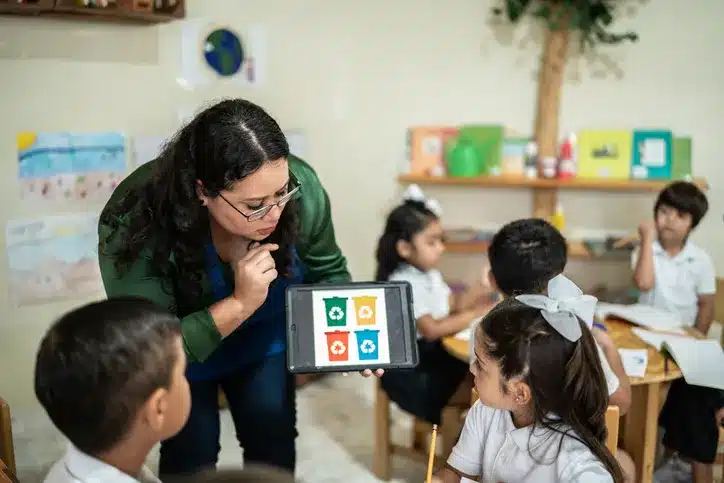
What Life Skills Do Children Learn Through Play?
Life skills are practical abilities that help people function independently and relate effectively to others. They include communication, decision-making, problem-solving, emotional regulation, cooperation, creativity, self-management, and resilience.
Play can exercise many of these abilities simultaneously. Consider a simple board game: a child has to remember rules, wait for a turn, cope with losing, make choices, read other players’ reactions, and sometimes change strategy. That is a surprisingly rich workout for a developing mind.
Problem-Solving and Decision-Making
Children encounter small problems constantly during play.
A block tower collapses. A puzzle piece does not fit. A pretend restaurant runs out of food. A team is losing a game. Instead of receiving an immediate solution from an adult, children can experiment with different responses.
This matters because effective problem-solving involves more than knowing the correct answer. Children need to identify a problem, consider possibilities, test an approach, notice what happened, and adjust their plan.
Open-ended toys are particularly useful because they do not dictate one correct outcome. Building blocks, cardboard boxes, art materials, puzzles, household objects, and construction sets can encourage children to ask, “What could I do differently?”
Communication and Cooperation
Social play is a miniature version of the social world.
Children have to explain ideas, listen, persuade, compromise, interpret facial expressions, and resolve disagreements. When two children want the same toy, for example, they may have to negotiate who uses it first or invent a new game that allows both to participate.
The AAP notes that peer play creates opportunities for negotiation and cooperation, while helping children develop more sophisticated language for interacting with others. American Academy of Pediatrics
Adults can support this without solving every disagreement. Asking, “What do you think would be fair?” is often more valuable than immediately deciding who is right.
Self-Control and Emotional Regulation
One of the less obvious benefits of play is that it gives children repeated practice managing impulses.
Executive function is the group of mental skills that helps people focus attention, hold information in mind, resist impulses, switch between tasks, and plan ahead. Harvard University’s Center on the Developing Child describes these abilities as essential for learning and everyday functioning, while emphasizing that they develop through interaction and practice rather than appearing fully formed at birth. Center on the Developing Child+1
Games such as “Simon Says,” “Red Light, Green Light,” hide-and-seek, and turn-taking board games naturally exercise these skills. A child may desperately want to shout out an answer or move before their turn, but the rules require them to pause.
That pause is practice.
Pretend play can also help children explore difficult emotions. A child who acts out a doctor treating a frightened patient, for instance, can experiment with ideas about fear, reassurance, responsibility, and care.
Creativity and Flexible Thinking
Real life rarely follows a perfect script. Children therefore need to become comfortable with uncertainty and changing circumstances.
Pretend play is particularly powerful here. A cardboard box can become a spaceship, shop, house, or animal shelter. The child decides what it represents and changes the rules as the story develops.
This kind of flexible thinking has practical value. Children learn that there can be several possible solutions to the same problem and that an unsuccessful attempt does not necessarily mean the activity is over.
The AAP identifies creativity, problem-solving, collaboration, negotiation, decision-making, and leadership among the competencies that can be strengthened through play. American Academy of Pediatrics

Physical Play Builds More Than Motor Skills
Running, climbing, jumping, throwing, balancing, dancing, and playing sports obviously help children develop coordination and physical confidence. But physical play also creates opportunities to practice persistence, judgment, cooperation, and risk assessment.
A child climbing on playground equipment has to judge where to place a foot, decide whether a movement feels manageable, and sometimes retreat and try another route. With appropriate supervision and a reasonably safe environment, these experiences can build confidence without removing every challenge.
Physical activity also matters for health. The World Health Organization recommends that children aged 5–17 accumulate an average of at least 60 minutes of moderate-to-vigorous physical activity per day across the week. For younger children, WHO recommends substantially more total physical activity: children aged 1–4 should have at least 180 minutes of physical activity spread throughout the day, with children aged 3–4 getting at least 60 minutes of moderate-to-vigorous activity. World Health Organization+1
These recommendations are about health rather than “life-skills training,” but active play can help children meet them while developing physical competence at the same time.
The Difference Between Free Play and Guided Play
Not all play needs to be completely unstructured, and adults do not need to choose between leaving children entirely alone and turning every game into a lesson.
Free play gives children control over what they do and how they do it. That freedom supports agency, imagination, experimentation, and independent decision-making.
Guided play occupies a useful middle ground. The adult creates an environment or introduces a question while allowing the child to remain actively involved. For example, rather than showing a child exactly how to build a bridge from blocks, a parent might ask, “How could we make it strong enough for the toy car to cross?”
The AAP describes guided play as child-led and joyful while adults shape the environment to support learning. American Academy of Pediatrics Harvard’s play resources likewise emphasize games and playful activities as opportunities to practice attention, working memory, and self-control. Center on the Developing Child
The distinction matters because too much adult direction can turn play into another assignment. The goal is not to squeeze a lesson out of every activity. It is to create conditions in which useful skills can emerge naturally.
Everyday Play Ideas That Build Life Skills
Parents do not need expensive educational toys or elaborate activities. Ordinary situations can provide excellent opportunities.
- Cooking together: Children can measure ingredients, follow sequences, make choices, and learn that mistakes can sometimes be fixed.
- Building with blocks: Construction encourages planning, spatial reasoning, experimentation, and persistence.
- Board and card games: These provide practice with memory, attention, turn-taking, strategy, rule-following, and handling disappointment.
- Pretend shops or restaurants: Children practice communication, counting, social roles, decision-making, and negotiation.
- Outdoor obstacle courses: These develop coordination while encouraging children to plan routes and judge manageable challenges.
- Art and craft projects: Open-ended creative activities allow children to make decisions without one predetermined “correct” result.
- Storytelling games: Taking turns adding to a story strengthens language, listening, imagination, and cognitive flexibility.
- Household role-play: Playing “home,” “office,” “school,” or “clinic” allows children to imitate responsibilities they observe in everyday life.
The best activity is often the one a child genuinely wants to keep doing.These figures should not be interpreted as proof that a particular game will produce a particular life outcome. Play research is broad, and effects vary according to a child’s age, development, environment, the type of play, and the quality of adult or peer interaction.
How Parents Can Encourage More Skill-Building Play
The simplest approach is to make room for play rather than trying to optimize every minute of it.
Give children some uninterrupted time to decide what they want to do. Keep a mixture of open-ended materials available. Join them when invited, but resist taking over the activity.
When a problem appears, pause before providing the answer. Questions such as “What could we try next?” or “Why do you think that happened?” encourage children to think through the situation themselves.
It is also worth allowing children to experience manageable frustration. Losing a game, rebuilding a fallen tower, or discovering that an idea does not work can be uncomfortable, but these moments provide valuable practice in persistence and emotional regulation.
At the same time, safety and developmental appropriateness matter. Children need reasonable boundaries, supervision where necessary, and adaptations when a disability or other individual need affects participation. UNICEF emphasizes that learning through play is not a one-size-fits-all approach and should reflect children’s cultural and social contexts. UNICEF
Perhaps most importantly, adults should avoid measuring play only by what a child appears to “learn.” Sometimes a child is simply enjoying themselves. That is not wasted time. Enjoyment is part of what makes voluntary play engaging enough for children to keep experimenting and practicing.

Frequently Asked Questions
Is play really as valuable as formal learning?
Play and formal instruction serve different purposes, and children need both. Evidence supports play as an important context for developing social, emotional, cognitive, physical, and creative skills, particularly when children are actively engaged. UNICEF+1
What are the best toys for developing life skills?
There is no single “best” toy. Open-ended materials such as blocks, puzzles, art supplies, pretend-play props, balls, and simple games can be highly useful because children have to make decisions and generate their own ideas.
Should parents play with their children all the time?
No. Adult participation can be valuable, especially for younger children, but independent and peer play are important too. A useful balance is to join children regularly, follow their lead, and gradually step back as they become more capable of managing play themselves. Center on the Developing Child
How much play does a child need?
There is no universal number of hours that captures all forms of play. Physical-activity guidelines provide useful health benchmarks, but children also need opportunities for imaginative, social, creative, and quiet play. The quality and variety of experiences matter alongside the amount of time available.
Conclusion
Play gives children something that worksheets and instructions cannot easily reproduce: a reason to use skills because the situation matters to them.
When children negotiate the rules of a game, rebuild a failed structure, invent an imaginary world, wait for a turn, comfort a pretend patient, or figure out how to cross a playground, they are rehearsing real-world abilities. They are learning to think, communicate, manage themselves, cooperate, adapt, and persist.
For parents, the takeaway is reassuring. Developing life skills does not require turning childhood into a training program. Give children time, space, interesting materials, supportive relationships, and opportunities to solve manageable problems themselves. Then let play do what it has always done best: give children a place to practice becoming capable people.
Related Posts


