

When a child joins a football, basketball, volleyball, cricket, or hockey team, they learn much more than how to pass, shoot, defend, or score. Team sports also teach children how to communicate, cooperate with others, handle pressure, recover from disappointment, take responsibility, and contribute to something bigger than themselves.
This combination makes team sports a powerful environment for personal development. While the benefits are not automatic—a poorly supervised or overly competitive team can create unnecessary stress—a supportive and inclusive sporting environment can help children develop physical, social, and emotional skills that remain valuable throughout their lives.

1. Building Confidence and Self-Esteem
Team sports can give children a meaningful confidence boost. Learning a new skill, improving through practice, and contributing to a team can help children recognise their own abilities.
The encouragement they receive from teammates and coaches can also make a significant difference. When children feel supported, they are often more willing to take risks, try unfamiliar skills, and keep going when something does not work the first time.
Small achievements—such as learning a new technique, making a good pass, or helping the team during a game—can gradually build self-confidence. Over time, this confidence can extend beyond sport and influence how children approach school, friendships, and other challenges.
2. Learning Teamwork and Cooperation
One of the most valuable lessons team sports teach is how to work with other people.
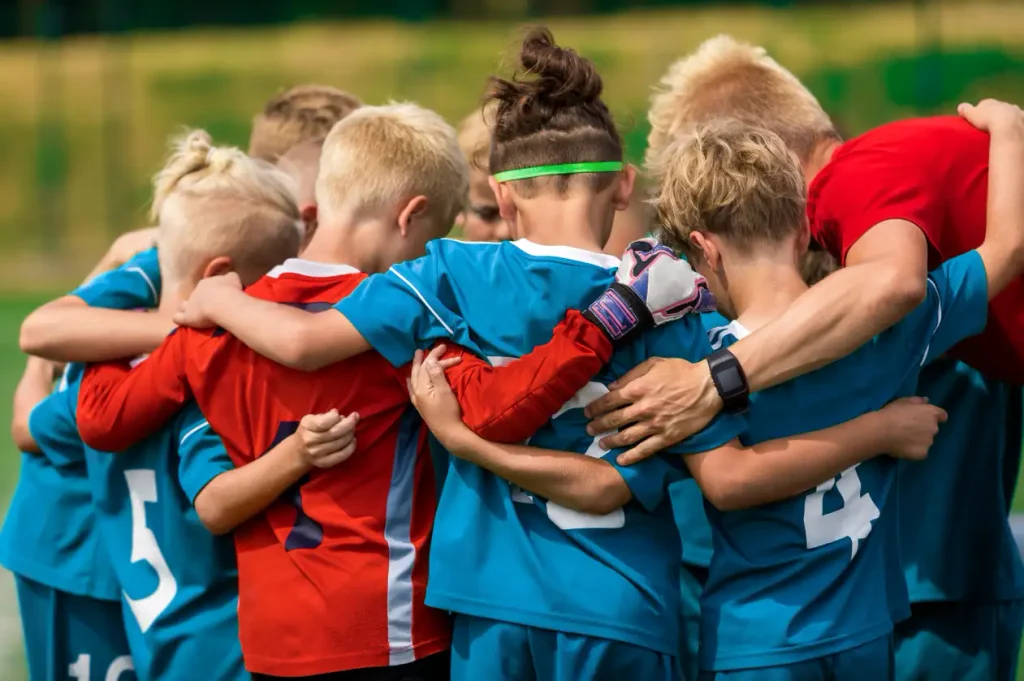
Children quickly discover that success is rarely about one player doing everything alone. They need to communicate, listen, share opportunities, trust their teammates, and understand their role within the group.
They also learn that supporting others matters. When children experience encouragement from teammates, they often learn to offer that same encouragement in return. These habits can help them build healthier relationships and cooperate effectively in school, family life, and eventually the workplace.
3. Learning How to Win and Lose Gracefully
Winning feels great, but learning how to handle defeat is just as important.
Losing a game can be disappointing, particularly for children who have worked hard and expected a different result. Team sports provide an opportunity to teach children that disappointment is a normal part of life and that losing does not mean they have failed as a person.
Coaches can help young athletes focus on effort, learning, and improvement rather than simply looking at the final score. Children can also learn good sportsmanship by congratulating opponents, respecting officials, and remaining positive after a difficult game.
Learning to celebrate a victory without putting others down is equally important. These experiences help children develop emotional resilience and a healthier attitude toward competition.
4. Developing New Skills
Team sports encourage children to keep learning and improving.
Watching teammates practise can inspire young athletes to develop their own abilities. Coaches can introduce new techniques and challenges that encourage children to move beyond what they already know.
Whether a child is learning to dribble a football, serve a volleyball, bowl a cricket ball, or defend in hockey, the process teaches patience and persistence. Children begin to understand that improvement usually comes through regular practice rather than instant success.
5. Developing Discipline and Accountability
Being part of a team means that other people depend on you.
Children learn that they need to arrive on time, bring the right equipment, follow instructions, respect the rules, and make a genuine effort during practices and games. If they regularly miss training or fail to prepare, their teammates may be affected as well.
This creates a natural sense of accountability. Children begin to understand that their choices can affect other people, which is an important lesson for life beyond sport.
Team sports can also teach children to follow routines and stay committed to something even when they are not always in the mood to practise.
6. Building Resilience and Emotional Skills
Sport does not always go according to plan. A child may miss an important shot, lose a match, make a mistake, or struggle to learn a particular skill.
These moments can be difficult, but they also create valuable opportunities for growth.
With appropriate guidance, children can learn to manage frustration, stay calm under pressure, accept constructive feedback, and try again after making mistakes. Instead of seeing setbacks as reasons to quit, they can learn to view them as part of the learning process.
This resilience can be useful in many other areas of life, including academics, friendships, and future work.
7. Encouraging Communication
Good communication is essential in almost every team sport.
Children need to listen to coaches, communicate with teammates, ask questions, give encouragement, and sometimes make quick decisions during a game. They learn that communication is not just about speaking; it is also about paying attention and understanding other people’s perspectives.
These communication skills can gradually help children become more comfortable expressing themselves and working with different personalities.
8. Spending Less Time on Screens
Children today spend a significant amount of time using phones, tablets, computers, televisions, and gaming devices. Team sports provide a valuable opportunity to step away from screens and interact with people face-to-face.
Practices and games give children time to move, talk, cooperate, and build genuine friendships. These real-world interactions can contribute to their social development while also providing a healthy break from digital entertainment.
9. Staying Active While Having Fun
Perhaps one of the simplest benefits of team sports is that they make physical activity enjoyable.
Children who enjoy their sport are more likely to look forward to practices and games rather than seeing exercise as a chore. They may also become motivated to practise independently because they genuinely want to improve.
Regular participation in sport can help children develop active habits that may continue into adolescence and adulthood.
The U.S. Centers for Disease Control and Prevention recommends that children and adolescents aged 6 to 17 get at least 60 minutes of moderate-to-vigorous physical activity each day. Team practices and games can contribute to that goal while offering additional social and emotional benefits.
Discipline Without Losing Enjoyment
Discipline is an important part of learning any sport. Children need to repeat skills, follow instructions, concentrate during training, and continue practising even when a particular exercise is challenging or less exciting.
However, effective discipline does not have to mean pressure or fear.
Children are more likely to develop lasting habits when they understand why practice matters and continue to enjoy the activity. Parents and coaches can support this by praising effort, improvement, teamwork, and sportsmanship rather than focusing only on winning.
A child who enjoys their sport is also more likely to stay active and involved over the long term.
What Age Should Children Start Team Sports?
There is no single perfect age for every child to start team sports.
Younger children often benefit most from playful, flexible activities that focus on movement, basic coordination, and having fun rather than formal competition. As children grow, they can gradually learn more structured rules, positions, tactics, and teamwork.
The most important factor is that the activity should be appropriate for the child’s age, interests, ability, and emotional development.
What If My Child Is Not Athletic?
Children do not need to be naturally athletic or highly skilled to benefit from team sports.
Recreational teams, beginner programmes, modified games, and inclusive community leagues can provide opportunities for children of different abilities to participate without the pressure associated with elite competition.
The goal should not be to create a professional athlete. The goal is to give children a positive environment where they can move, learn, make friends, build confidence, and discover their strengths.

How Parents Can Support Their Child
Parents play an important role in making sports a positive experience.
Instead of asking only, “Did your team win?”, parents can ask questions such as:
- “What did you enjoy about practice today?”
- “What new skill did you learn?”
- “What was challenging?”
- “How did you help your teammates?”
- “What would you like to improve next time?”
These questions encourage children to focus on learning and personal growth rather than believing that winning is the only measure of success.
Conclusion
Team sports can play an important role in a child’s personal development because they combine physical activity with meaningful social experiences.
Through practices and games, children learn communication, cooperation, discipline, accountability, confidence, resilience, and sportsmanship. They experience both success and disappointment while learning how to respond to each.
The strongest benefits are likely to come from environments that are inclusive, age-appropriate, supportive, and enjoyable. A child does not need to become a champion to gain something valuable from sport.
Ultimately, team sports give children a place to improve, contribute, build relationships, handle setbacks, and discover that personal growth is often easier—and more enjoyable—when it happens as part of a team.
Related Posts


