Introduction
Somewhere between the excitement of raising a bilingual child and the reality of daily life, most parents hit the same wall: nobody agrees on the “right” way to do it. Ask five bilingual families how they split their languages at home and you’ll likely get five different answers, plus a few strong opinions about why their method is the one that actually works.
Two strategies dominate the conversation. One Parent, One Language (OPOL) has each parent stick to a single language with the child, regardless of what’s happening around them. Minority Language at Home (ML@H) takes a different approach: the whole family speaks the less-dominant language indoors, while the community language stays outside the front door. Both have passionate advocates, both have real research behind them, and both can fail if a family picks the wrong fit for their circumstances.
This isn’t really a question of which method is objectively superior. It’s a question of which one matches how your household actually functions.
What OPOL Actually Looks Like
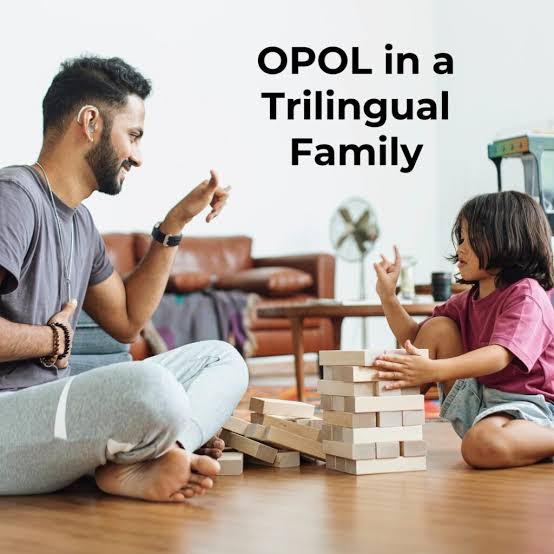
The idea traces back further than most people expect — French linguist Maurice Grammont floated it in writing at the start of the 20th century, and it has anchored bilingual parenting advice in Europe and Canada ever since. In practice, each parent commits to one language exclusively with the child. A French-speaking mother speaks only French to her son; his English-speaking father speaks only English. The child, in theory, learns to associate each language with a specific person and switches accordingly.
The appeal is obvious. It’s simple to explain, easy to picture, and gives each parent a clear, unambiguous role. It also builds a direct emotional bond between a language and a relationship — many adult bilinguals who grew up this way describe a specific language as “how I talk to my dad” or “the words I use with my mom.”
But OPOL asks a lot of consistency from parents, and that consistency is harder to maintain than it sounds once a child starts school, makes friends, and begins pushing back in the majority language. Sociolinguist Annick de Houwer’s large-scale survey of families in Flanders found that a notable share of children raised under strict OPOL did not end up actively bilingual — the strategy didn’t guarantee the outcome parents hoped for, even when both parents genuinely stuck to their assigned language.
Facts and Figures Worth Knowing
A few data points are worth keeping in mind when weighing the two approaches, drawn from published bilingualism research rather than anecdote:
- In de Houwer’s survey of roughly 1,450 households in Flanders, close to 80 percent of families were not using strict OPOL at all — most had settled into some version of a shared minority-language household or a hybrid arrangement.
- Among that same sample, families using a one-language-per-household model reported active bilingualism in about 79 percent of children, compared with about 74 percent for OPOL families and 59 percent for families mixing languages inconsistently.
- A parallel dataset of bilingual Japanese families showed a similar pattern, with one-language-per-household families reporting active bilingual outcomes around 93 percent, versus roughly 83 percent for OPOL households.
- Perhaps the most telling variable wasn’t which parent spoke which language — it was whether the parents spoke the minority language to each other. Households where parents used the minority language between themselves saw dramatically higher rates of the child speaking both languages actively than households where parents defaulted to the majority language when talking to one another.
None of this means OPOL is a poor choice — three out of four children in OPOL households in these surveys did become active bilinguals. It does suggest that the household’s overall linguistic atmosphere, not just who speaks what to the child, is doing a lot of the real work.
When Minority Language at Home May Be Better
Minority Language at Home can be especially powerful when both parents speak the minority language well.
Suppose a family in Australia speaks Vietnamese at home while the child encounters English everywhere else. Using Vietnamese for meals, family conversations, bedtime stories, jokes, and everyday routines gives the child a substantial amount of natural exposure.
It also avoids placing the entire responsibility for transmission on one parent.
A 2025 Australian study of 280 families found that alternative family policies—including approaches in which both parents consistently used the heritage language—could be perceived as equally or more effective for heritage-language maintenance than OPOL. The study is based on families’ self-reported experiences, so it should not be treated as proof that one policy universally outperforms another.
Practical Considerations Before You Choose
A few questions tend to clarify which direction fits a specific household:
- Does the minority-language parent have enough one-on-one time with the child to sustain OPOL, or would that language get squeezed out by sheer lack of hours?
- Is the majority language already dominant everywhere else — school, extended family, media — such that the home is the only realistic space left for the minority language?
- Can both parents commit to using the minority language with each other, at least some of the time, to reinforce it beyond parent-child conversation?
- Is there a support network — grandparents, a heritage-language playgroup, weekend school — that can extend exposure beyond what one parent alone can provide?
Families sometimes discover partway through that their chosen method needs adjusting, and that’s normal. A strategy that worked when a child was two may need rethinking once they start school and spend eight hours a day immersed in the majority language.
Frequently Asked Questions
Can a family combine OPOL and ML@H? Yes, and many effectively do. A common variation has one parent speak a minority language exclusively (OPOL) while the whole family also defaults to that language at home, layering both strategies together.
Does OPOL confuse children linguistically? Research doesn’t support this concern. Bilingual children are capable of separating languages from early on; the challenge with OPOL is exposure quantity, not confusion.
How much daily exposure does a minority language typically need? There’s no single verified threshold, but researchers generally agree that consistent, substantial exposure — not just occasional contact — is what predicts active bilingualism, which is part of why household-wide strategies like ML@H tend to perform well.
Is it too late to switch strategies with an older child? No. Language input strategies can be adjusted at any age, though older children may need more deliberate motivation and social opportunities to actively use the minority language, rather than just hear it.
Conclusion
Neither OPOL nor Minority Language at Home is a guaranteed formula, and the research on both is a useful reality check against the internet’s more confident claims. What the data does suggest is that concentrating a minority language’s presence — whether through a shared home-language policy or a well-supported OPOL arrangement — tends to matter more than which label a family puts on their approach. The households that do best generally treat the minority language as something with real social weight in daily life, not a task assigned to one parent to carry alone.
Related Posts