Introduction
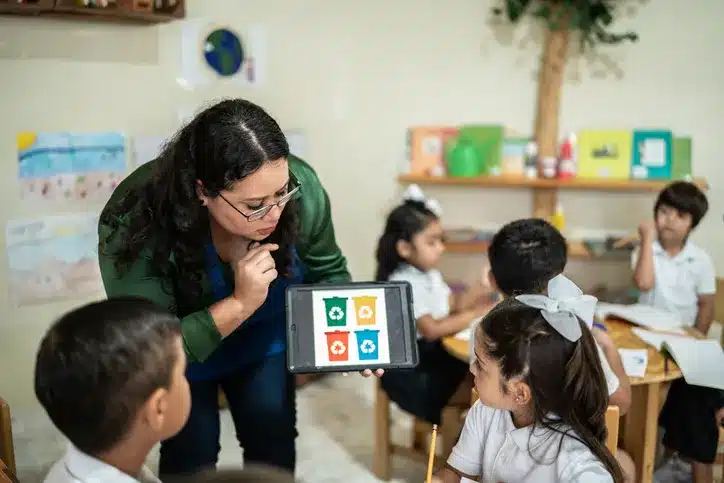
For many children, learning no longer begins and ends with a textbook, a classroom board, and a teacher at the front of the room. A child struggling with fractions can practise on an interactive app, listen to an explanation again, watch a visual demonstration, or receive immediate feedback from a digital tutor. A student who cannot easily access printed material can use text-to-speech, captions, or other assistive technologies. And increasingly, artificial intelligence is entering the picture, offering new ways to personalize learning and help teachers understand where students need support.
But technology is not automatically educational simply because it is digital. The evidence paints a more complicated picture. Educational technology can make learning more accessible, interactive, and individualized, yet poorly designed or poorly managed technology can distract children, widen inequalities, expose sensitive data, or simply consume money without improving learning.
The real question, then, is not whether technology belongs in children’s education. It is how, when, and why it should be used.

What Educational Technology Actually Means
Educational technology, often shortened to EdTech, covers far more than tablets and classroom computers. It includes learning-management systems, educational games, adaptive learning software, online libraries, video lessons, virtual and augmented reality, assessment platforms, assistive technologies, and increasingly AI-powered tools.
UNESCO’s 2023 Global Education Monitoring Report describes digital technology as serving several roles: delivering educational content, supporting teaching, developing digital skills, managing education systems, and creating new opportunities for interaction and learning. The report also stresses that technology’s effects vary considerably depending on the tool, context, teacher preparation, and way it is implemented.
That distinction matters. A tablet sitting unused on a desk does little for a child’s education. A carefully chosen program that gives a child targeted practice while a teacher works with another group can be genuinely useful.
How Technology Is Changing the Way Children Learn
Learning can become more personalized
Traditional classrooms have an unavoidable constraint: one teacher may be responsible for many children with very different levels of understanding.
Digital platforms can help address part of that problem. Some programs adjust the difficulty of questions according to a student’s previous answers. Others provide immediate feedback or identify particular skills where a learner needs more practice.
Research summarized by the Education Endowment Foundation suggests that individualized instruction can improve attainment, although implementation matters greatly. Digital technology can support individualized activities, assessment, and feedback, but the evidence also indicates that technology works best as a supplement to strong teaching rather than as a replacement for teacher interaction.
Imagine a primary-school mathematics lesson. Instead of every child completing exactly the same worksheet, a teacher might use software to give one group practice with multiplication while another works on fractions. The teacher can then spend more time with children who need direct explanation.
The important ingredient is not the software itself. It is the ability to respond to individual learning needs.
The Problems Schools and Parents Cannot Ignore
Screens can become a distraction
The same device that contains a mathematics lesson may also contain games, social media, messages, and countless other distractions.
OECD PISA 2022 data found that around 30% of students across OECD countries reported being distracted by digital devices in most or every mathematics lesson. Students who reported this frequent distraction scored, on average, 15 points lower in mathematics than students who said it never or almost never happened, after accounting for students’ and schools’ socioeconomic profiles. OOECD+1
This does not prove that digital devices caused the lower scores. Students who struggle academically may behave differently with technology, and classrooms differ in many other ways. Still, the finding is a useful warning: giving every child a device does not automatically create a better learning environment.
OECD evidence also suggests that the type and purpose of technology matter. Educational software was associated with less distraction than some other forms of device use, while frequent smartphone use was associated with greater distraction. OOECD
The digital divide remains real
Technology can expand access, but only for people who can actually use it.
UNICEF reported in The State of the World’s Children 2024 that nearly 26% of people in low-income countries were connected to the internet, compared with more than 95% in high-income countries. UUNICEF
The divide is not simply about owning a laptop. It can involve electricity, broadband quality, device sharing, data costs, technical support, accessible software, and whether parents have the time and skills to help children use digital resources.
A school that assumes every child can continue an online assignment at home may unintentionally disadvantage children who share one phone among several family members or have unreliable connectivity.
Children’s data and privacy need protection
Many digital learning systems collect information about students: names, assignments, performance, attendance, interactions, and sometimes behavioral data.
AI introduces additional questions. Parents and schools need to know what information a system collects, where it goes, how long it is retained, and whether it is used to train other systems.
For children, privacy cannot be treated as a minor technical issue. A student’s mistakes, learning difficulties, and personal information can follow them for years.

More technology does not necessarily mean better learning
This may be the most important lesson from the research.
UNESCO’s 2023 report concluded that robust evidence about the added value of educational technology remains limited. It notes that systematic reviews generally find small to medium positive effects for some technology-supported approaches, but studies do not always isolate the contribution of technology itself from other factors such as additional teaching time, resources, or teacher support. 22023 GEM Report+1
UNESCO also found that education technology products evolve so quickly that evaluation often struggles to keep pace. The report says EdTech products change, on average, every 36 months. 22023 GEM Report
In other words, schools should be skeptical of claims that a particular app or platform will “transform” learning. The sensible question is: What problem does this tool solve, and is there evidence that it solves it well?
What Effective Educational Technology Looks Like
The strongest approach is usually not “technology everywhere.” It is technology with a purpose.
Schools and parents can start with a few practical questions:
- What specific learning problem is the technology meant to solve?
- Does research support the tool or the instructional approach behind it?
- Does it make learning clearer, more accessible, or more engaging?
- Can teachers see useful information about student progress?
- Does it protect children’s privacy?
- Can children without expensive devices or fast internet participate?
- What happens when the technology fails?
- Does it give teachers more capacity to teach, rather than creating another administrative burden?
Teachers also need professional development. A technically capable teacher may still need guidance on when a digital activity is pedagogically useful and when a paper exercise, discussion, experiment, or face-to-face explanation would work better.
The Education Endowment Foundation similarly emphasizes that evidence should inform decisions but should not replace professional judgment about a school’s particular context.
The Growing Role of Artificial Intelligence
AI is likely to be one of the biggest changes in educational technology over the next several years.
How Technology Is Changing the Way Children Learn
Generative AI can explain concepts in different ways, create practice questions, help teachers prepare materials, translate information, and potentially provide personalized support. For children with different learning needs, AI may also offer more flexible ways to interact with educational content.
Yet AI creates problems that older educational software did not necessarily have. AI systems can produce incorrect information, reinforce biases, encourage students to outsource thinking, and collect sensitive information. Younger children may also have difficulty recognizing when an AI-generated answer is unreliable.
UNICEF’s 2025 guidance therefore recommends child-centered AI that emphasizes safety, privacy, fairness, transparency, inclusion, children’s development,
The goal should not be to give children an AI answer to every question. It should be to help them become better at asking questions, checking evidence, solving problems, creating things, and thinking independently.
Frequently Asked Questions
Does educational technology improve children’s grades?
Sometimes, but not automatically. Research shows positive effects for some technology-supported approaches, particularly when technology strengthens established teaching practices such as practice, feedback, assessment, and individualized instruction. The overall evidence is mixed, and technology by itself is not a substitute for effective teaching. 22023 GEM Report+1
How much screen time should children have for learning?
There is no single number that determines whether educational screen use is beneficial. The purpose, content, age of the child, type of activity, and what the screen replaces all matter. A collaborative science simulation is very different from passive entertainment, even if both involve a screen.
Can AI replace teachers?
There is little reason to treat that as the desirable goal. Technology can automate certain tasks and provide additional support, but children still need human explanation, encouragement, relationships, judgment, discussion, and guidance. UNESCO recommends using digital technologies to support education based on human interaction rather than attempting to substitute for it. UUNESCO
What is the biggest risk of educational technology?
There is no single biggest risk. Poor implementation can lead to distraction, wasted spending, unequal access, privacy problems, weak learning, or excessive dependence on technology. The risks increase when schools adopt tools before establishing clear educational goals and safeguards.
Conclusion
Educational technology is changing children’s learning, but the change is more nuanced than the simple idea that classrooms are becoming “digital.”
The best technology can give children faster feedback, more personalized practice, broader access to information, and new ways to communicate and create. It can also make education more accessible for learners who have traditionally faced barriers.
At the same time, devices can distract, digital access can be unequal, and children’s data can be vulnerable. Most importantly, the research does not support the idea that
Related Posts