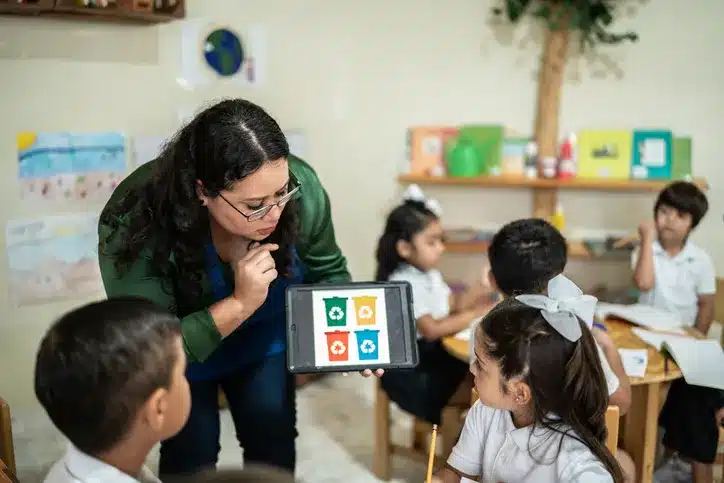
The classroom your child sits in today looks remarkably similar to the one you sat in decades ago—rows of desks, a teacher at the front, standardized tests determining progress. But the world outside those walls has changed beyond recognition, and education is finally catching up.oecd+1
For parents watching their children navigate homework on tablets while preparing for careers that don’t yet exist, the question isn’t whether education will transform—it’s whether that transformation will prepare kids for what’s actually coming.pmc.ncbi.nlm.
Why Education Can’t Stay the Same
The pace of technological change has rendered the traditional “learn once, work forever” model obsolete. Artificial intelligence, automation, and global connectivity are reshaping what skills matter and how quickly they become outdated.
The World Economic Forum’s analysis of future workforce needs identifies analytical thinking, creative problem-solving, and digital literacy as core competencies for 2030—skills that don’t emerge from memorization-based curricula. Meanwhile, the education technology market, valued at approximately $187–190 billion in 2025, is projected to reach between $214 billion and $417 billion by 2026 alone, depending on how broadly you define the sector.finance.yahoo+9
This isn’t just about adding computers to classrooms. It’s about fundamentally rethinking how learning happens when information is ubiquitous and adaptability matters more than static knowledge

The Shift Toward Personalized Learning
One of the most significant changes underway is the move from one-size-fits-all instruction to personalized learning pathways. AI-powered adaptive learning systems can now adjust content difficulty, pacing, and teaching style based on individual student performance in real time.
Research published in 2025 and 2026 shows that AI-enabled personalized learning can produce moderate to large positive effects on student outcomes, with meta-analyses reporting effect sizes ranging from 0.50 to 0.70 across different contexts. In mathematics specifically, AI-driven personalized interventions have demonstrated stronger impacts (around 0.27 standard deviations) compared to language arts (0.18 standard deviations).pmc.ncbi.
What Personalized Learning Actually Looks Like
Rather than waiting for a teacher to notice confusion, adaptive platforms identify knowledge gaps immediately and provide targeted support. A student struggling with fractions might receive additional visual explanations and practice problems, while another who’s mastered the concept moves ahead without waiting for the class average.
This approach mirrors how people actually learn outside school—through iteration, immediate feedback, and content matched to their current level. Studies of AI-powered personalized learning in high school settings suggest improvements in both academic performance and student engagement when implemented alongside teacher guidance.
Skills That Will Matter More Than Grades
The competencies that will define success in the coming decades extend well beyond traditional academic metrics. The World Economic Forum’s Core Skills 2030 framework identifies ten critical skill clusters, including:
Cognitive skills: analytical thinking, problem-solving, critical reasoning
- Self-management: resilience, adaptability, motivation
- Interpersonal abilities: leadership, collaboration, empathy
- Digital literacy: AI awareness, data management, cybersecurity basics
- Innovation capabilities: curiosity, creative thinking, experimentation
- Learning skills: metacognition, reflective thinking, self-directed learning
These aren’t taught through standardized testing or lecture-based instruction. They emerge from project-based learning, real-world problem-solving, and environments where failure is treated as data rather than defeat.
The Technology Reshaping Classrooms
Beyond AI-driven personalization, several technological trends are transforming how education is delivered:
Virtual and augmented reality are making abstract concepts tangible—students can explore molecular structures in 3D or walk through historical events rather than reading about them. Learning analytics provide teachers with detailed insights into student progress, enabling earlier interventions. Cloud computing and mobile devices mean learning isn’t confined to school hours or physical classrooms.
The Equity Challenge Nobody’s Solving Fast Enough
Technology’s promise comes with a significant caveat: it can widen existing inequalities as easily as it closes them. The digital education divide extends beyond device access to include digital literacy, teacher training, institutional support, and cultural inclusion.Students in under-resourced schools may lack reliable internet, updated devices, or teachers trained in digital pedagogy—creating a two-tier system where privileged students benefit from personalized AI tutors while others fall further behind. Research from 2026 emphasizes that technology expansion alone cannot reduce educational inequality without inclusive pedagogy, sustained teacher development, and equitable infrastructure.

Addressing this requires more than donating laptops. It demands systemic investment in teacher training, curriculum redesign, and policies ensuring all students can meaningfully participate in digital learning
What Parents Can Do Now
You don’t need to wait for school systems to transform completely. Several practical steps can help prepare children for the educational future:
- Encourage curiosity over compliance: Reward questions and exploration, not just correct answers.weforum+1
- Normalize failure as learning: Help kids see mistakes as data points rather than character flaws.
- Develop digital literacy early: Teach critical evaluation of online information, not just device usage.
- Prioritize soft skills: Collaboration, communication, and emotional intelligence matter as much as academic performance.
- Stay engaged with school technology: Understand what platforms your child uses and how they’re being implemented
The Bottom Line
The future of education isn’t a distant possibility—it’s unfolding now, shaped by technological capability, workforce demands, and growing recognition that traditional models no longer serve students. For today’s kids, this means learning will become more personalized, more flexible, and more focused on adaptable skills than static knowledge.oecd+5
But technology alone won’t guarantee better outcomes. The schools and families that thrive will be those that use these tools intentionally—prioritizing equity, maintaining human connection, and preparing children not just for specific careers, but for a lifetime of continuous learning in an unpredictable world.weforum+2
The question isn’t whether education will change. It’s whether we’ll guide that change in directions that actually serve the children living through it
Related Posts