The Developmental Timeline of Writing Directionality
Reversing letters like b, d, p, and q is entirely normal for children aged four through seven who are learning to write. The human brain naturally ignores object orientation during early visual development, so a child must explicitly learn that letter direction changes meaning. If your child is under seven, these mistakes reflect standard brain development rather than a learning disability.
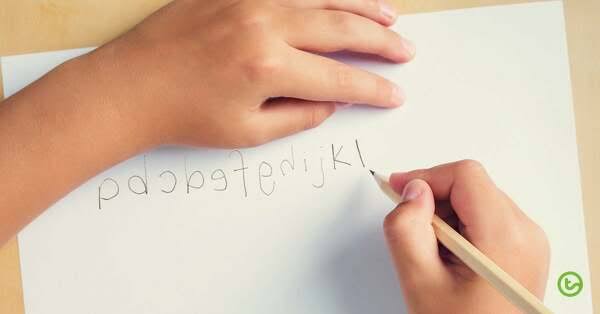
Children aged four and five are just beginning to understand that abstract symbols carry specific meanings. At this age, writing letters backward, upside down, or right to left is standard behavior. Children frequently mirror their entire name when writing on unlined paper. You do not need to intervene aggressively at this stage beyond gentle modeling.
Between six and seven years old, formal reading and writing instruction helps most children consolidate spatial awareness. Letter reversals usually peak around kindergarten or early first grade as writing frequency increases. By the end of first grade, consistent reversals usually begin to fade on their own. Occasional flips may still happen when a child is tired or writing quickly.
By age eight, or during second grade, letter orientation should be well established in typical development. Persistent reversals past this age suggest that the child needs targeted instruction or a professional assessment. Catching persistent difficulties at eight ensures that reading comprehension is not derailed by fundamental decoding struggles.
Why the Brain Flips Mirror-Image Characters
For the first four years of life, a child learns that an object retains its identity regardless of its orientation. A chair facing left is still a chair when turned to face right. A dog looking over its shoulder does not become a completely different animal. The visual processing center in the brain, known as the fusiform gyrus, relies on this concept of object invariance to make sense of the physical world.
When children learn to read and write, their visual systems must unlearn object invariance specifically for arbitrary linguistic symbols. A circle with a vertical line on the left is a b, but moving that line to the right transforms it into a d. This requires the brain to repurpose neural pathways that previously ignored spatial orientation. This process, called neuronal recycling, takes years of practice to automate.
Writing also requires heavy working memory capacity from young children. A six-year-old writing a simple sentence must recall spelling, manage pencil grip, align letters on a baseline, and maintain posture simultaneously. When working memory is overloaded with mechanics, motor planning shortcuts happen. The child knows they need a stem and a loop, but the direction of that loop slips past their active focus.
Effective Exercises to Correct Letter Reversals at Home
Multi-Sensory Tactile Tracing
Tracing letters on textured surfaces helps build strong motor memory pathways in the brain. Have your child trace large letters formed out of sandpaper, or let them write in a shallow tray filled with salt or shaving cream. Always ensure they speak the letter sound aloud while forming the character. This pairs kinesthetic feedback with visual and auditory input to solidify letter shape.
Visual Anchor Cues
Visual anchors help children distinguish tricky mirror letters without relying solely on abstract left and right concepts. Teaching the bed image is a popular method, where the left hand forms the letter b and the right hand forms the letter d to mimic the headboard and footboard of a bed. Another helpful approach is reminding the child that b starts with a line, like a bat hitting a ball, whereas c and d start with a curved line. Visual cues give children a self-checking strategy when writing independently.
Gross Motor Orientation
Large body movements help internalize spatial orientation before fine motor pencil work takes place. Have your child walk out letter shapes on the living room rug or draw giant letters on an outdoor wall using sidewalk chalk. Engaging the shoulder and arm muscles builds spatial awareness faster than small finger movements on paper. Once the movement pattern is secure at a large scale, bring it down to standard handwriting lines.
How to Distinguish Normal Reversals from Dyslexia
Letter reversal alone is not a primary diagnostic indicator of dyslexia in young children. Dyslexia is rooted in phonological processing difficulties, which involve matching sounds to written symbols. A six-year-old who flips letters but easily breaks down words into sounds is experiencing normal motor development. A child struggling with core language processing exhibits a different set of symptoms altogether.
Watch for broader pattern indicators alongside persistent letter reversals after age seven. Children with dyslexia often struggle with rhyming words, recalling common sight words, and matching specific phonemes to letters. They may show severe avoidance of reading tasks, experience extreme fatigue during schoolwork, or swap whole word orders while reading aloud. If letter flipping occurs in total isolation without reading difficulties, visual tracking or motor planning is often the root cause.
Developmental IndicatorTypical Development (Ages 4 to 7)Potential Warning Sign (Age 8+)Reversal FrequencyOccurs frequently in daily writingPersists consistently in core wordsPhonological AwarenessCan isolate individual word sounds easilyStruggles to blend or segment basic soundsResponse to CuesSelf-corrects when reminded of promptsFails to notice reversals even when pointed outReading ImpactReads the word correctly despite writing flipMisreads b as d aloud consistently
Frequently Asked Questions
Should I correct my five-year-old every time they write a letter backward?
Constant correction at age five can create anxiety around writing and slow down creative expression. Instead, highlight correct letter forms during shared reading, or gently model the correct formation without erasing their work. Focus heavily on praise for accurate letter formation rather than criticizing every flipped letter.
Why does my child flip b and d, but not letters like m or t?
Letters like m and t are vertically symmetrical or distinct in shape, making them easier for the brain to categorize. Letters like b, d, p, and q are exact mirror images of one another, which triggers the brain’s object invariance instinct. The brain must work significantly harder to keep these specific mirror pairs organized.
Is mirror writing a sign that a child is left-handed or gifted?
Mirror writing, where a child writes entirely from right to left, is common among both left-handed and right-handed children learning motor control. Left-handed children naturally move their hand away from their body, which makes writing toward the left feel more intuitive initially. It is a standard stage of visual-spatial motor development and not a direct indicator of exceptional giftedness or neurological disorders.
How long should I practice letter direction exercises each day?
Short sessions lasting five to ten minutes are much more effective than long handwriting drills. Daily, consistent practice prevents mental fatigue and keeps the experience positive for early learners. Stop the session immediately if your child displays physical frustration or emotional distress.
When should I schedule a formal evaluation with a specialist?
Consider scheduling an evaluation if persistent letter reversals continue past age eight, or if your child struggles significantly with reading fluency and phonics in second grade. Start by consulting your child’s classroom teacher, followed by an occupational therapist for motor issues or a reading specialist for literacy challenges.
Practical Next Steps for Parents
Observe your child’s writing habits over the next two weeks without intervening every time a reversal happens. Note down which specific letters are flipping, what time of day the mistakes happen, and whether your child reads the letter correctly despite writing it backward. Bring these specific observations to your child’s teacher at your next conference to determine if classroom support or simple home practice is the best path forward.
Related Posts