Why This Question Keeps Coming Up at Pickup Lines and Pediatrician Visits
Ask any parent of a four-year-old how they feel about screen time, and you’ll usually get a sigh before an answer. Tablets get children through car rides, video calls buy ten minutes to make dinner, and a favorite show can be the difference between a peaceful morning and a meltdown. None of that makes anyone a bad parent — it makes them a parent living in 2026, when screens are simply part of the household furniture.
The tricky part is that the years before first grade are exactly when a child’s brain is doing its heaviest lifting: language explodes, attention spans form, and social skills get their first real workout. What happens on a screen during this window isn’t neutral. It either supports that development or competes with it, and the difference usually comes down to how screens are used, not just how long they’re on.
What the Guidelines Actually Say Now
For a long time, the go-to advice was simple and easy to repeat: no screens before age two, one hour a day after that. Parents liked it because it was concrete. Pediatric researchers were less fond of it, since a video call with a grandparent got treated the same as an hour of algorithm-fed cartoons.
That changed in early 2026, when the American Academy of Pediatrics moved away from a strict numeric cap and toward a framework built around content quality, context, and conversation rather than a stopwatch. The old benchmarks still show up as a reasonable starting point, though:
- Under 18 months: No screen use recommended, aside from video chatting with family.
- 18–24 months: If screens are introduced at all, it should be high-quality, co-viewed content — not solo tablet time.
- Ages 2–5: Roughly one hour a day of high-quality programming, watched together when possible.
The World Health Organization has landed in a similar place, also pointing to one hour a day as a reasonable ceiling for sedentary screen use in preschoolers, with less considered better. The American Academy of Child and Adolescent Psychiatry goes a step further with a weekday/weekend split — about an hour on school days, with a bit more flexibility on weekends for a family movie or a longer creative session.
None of these organizations are pretending a strict number captures everything that matters. As the AAP’s own guidance now puts it, the relationship between screen time and a child’s wellbeing depends heavily on what’s being watched, whether a parent is engaged alongside the child, and what the screen time is replacing.
Screen time is more than television
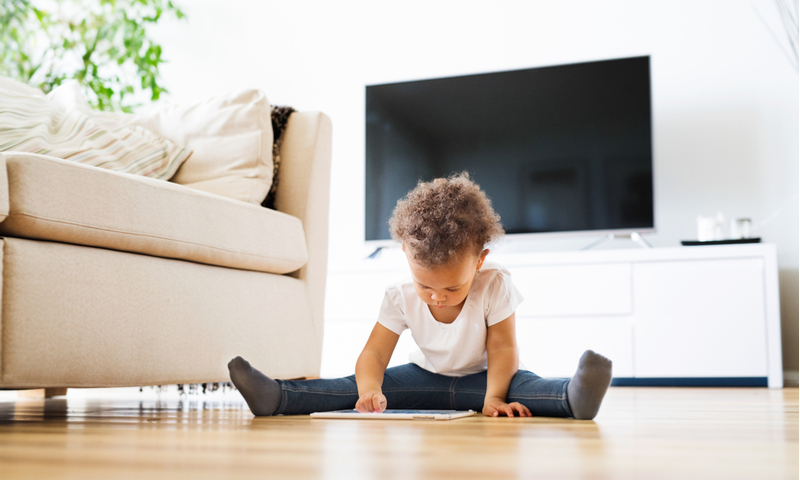
Today’s preschooler may encounter screens through television, tablets, smartphones, computers, streaming services, video games and educational apps. Background television also counts as part of the media environment even when a child is not sitting directly in front of it.
The AAP specifically advises families to create screen-free times and places, including during meals, and recommends keeping screens out of children’s bedrooms.
That makes the question “How many minutes did my child watch?” only part of the story. Parents should also ask what the child was watching, why the screen was being used, whether an adult was involved and what activity the screen replaced.
Physical effects of too much screen time
Screen time can also affect a child’s physical health by disrupting sleep habits or increasing risk for obesity. While enjoying screen time, some kids:
- Don’t drink enough water.
- Eat convenient, less nutritious snacks because they don’t want to leave their screens.
- Engage in less physical activity and have a more sedentary lifestyle.
- Neglect typical routines, such as going to bed on time, showering and teeth-brushing.
Parents may be surprised to learn that too much screen time can play a role in gastrointestinal (GI) issues, such as abdominal pain, constipation or cramps. This may happen in part because children can become so involved in screen time that other factors take a toll on their digestive and physical health, such as ignoring their body’s natural cues and delaying trips to the bathroom.
The “5 Cs” Parents Are Being Asked to Think About
Rather than asking “how many minutes,” the newer approach asks parents to run through five quick checkpoints, sometimes summarized as the 5 Cs:
- Child — every kid is different; what works for an easygoing three-year-old might overwhelm a more sensitive sibling.
- Content — educational, slow-paced, interactive content is a different experience than fast-cut videos designed to keep eyes glued to the screen.
- Calm — can the child wind down and fall asleep without a screen, or has it become a crutch?
- Crowding out — is screen time pushing out sleep, outdoor play, reading, or family conversation?
- Communication — are you talking with your child about what they’re watching, rather than just handing over the device?
This isn’t about being permissive. It’s a recognition that a preschooler doing an interactive counting app with a parent nearby is having a very different experience than one parked in front of autoplay content for the same sixty minutes.
Why the Years Before First Grade Are Different
Early childhood specialists point to a few reasons this age range deserves extra care:
Language development leans on live interaction. Toddlers and preschoolers pick up vocabulary and back-and-forth conversation skills far more efficiently from a responsive adult than from a screen, even an educational one. A show can introduce a word; a person helps a child actually use it.
Attention spans are still forming. Fast-paced, highly stimulating content can make slower-paced real-world activities — puzzles, picture books, imaginative play — feel comparatively boring, which can affect a child’s patience for tasks that require sustained focus, like sitting through a kindergarten lesson.
Sleep is especially vulnerable. Blue light exposure and stimulating content close to bedtime are linked to delayed sleep onset in young children, and preschoolers already need roughly ten to thirteen hours of sleep a night to support the rapid brain development happening at this stage.
Physical activity gets squeezed out. Time spent sitting with a device is time not spent running, climbing, or practicing the fine motor skills — cutting, drawing, buttoning — that kindergarten teachers will expect on day one.
Practical Ways to Set Limits Without a Daily Battle
- Build a simple family media plan. Decide together, out loud, when devices are used — maybe during a specific TV block, never at meals, never in bedrooms — so the boundary isn’t something you’re renegotiating every day.
- Sit in on some of it. Co-viewing turns passive watching into a conversation. Asking “what do you think happens next?” does more for language development than the show alone.
- Watch for the crowding-out effect, not just the clock. If screen time is displacing sleep, outdoor time, or reading, that’s a bigger signal than whether you hit exactly sixty minutes.
- Keep bedtime screen-free. Cutting off devices thirty to sixty minutes before bed gives the brain time to wind down naturally.
- Choose content over convenience when you can. Slower-paced, narrative shows tend to hold up better developmentally than fast-cut, reward-driven apps built to maximize engagement.
Frequently Asked Questions
Is one hour a hard limit or just a guideline? It’s a guideline, not a rule enforced by anyone but you. Pediatric groups treat it as a reasonable ceiling for a typical day, with room to flex occasionally — a long car trip or a sick day isn’t going to undo months of healthy habits.
Does video chatting with relatives count toward the limit? Most guidelines exempt live video calls, since they involve real back-and-forth interaction rather than passive viewing — the exact thing screen limits are trying to protect.
What if my child is already used to more screen time than recommended? Gradual reduction tends to work better than an abrupt cutoff. Trimming small blocks of time and replacing them with a specific alternative activity — not just “go play” — tends to stick.
Are educational apps automatically fine in unlimited amounts? Not necessarily. Even well-designed educational content can crowd out sleep, movement, and face-to-face interaction if it fills too much of the day, so the same general limits still apply.
The Bottom Line
There’s no perfect number of minutes that works for every four-year-old, and pediatric guidance has openly moved away from pretending there is. What stays consistent across every major recommendation is the underlying logic: keep screens from replacing sleep, movement, and real conversation, favor content that invites participation over content built to hold attention, and stay involved rather than treating the device as a babysitter. Get those pieces right, and the exact minute count matters a lot less than most parents worry it does.
Related Posts